United Arts Agency | UAA

Category Archives: Call for Artists

One of the greatest portraits ever painted by Renaissance artist Sandro Botticelli sold on January 28 at Sotheby’s New York for a record $92.2 million. In a sale that marked the first major auction of the year, Botticelli’s “Young Man Holding a Roundel” saw competitive transatlantic bidding between representatives in New York and London, with the final under-bidder bidding on behalf of a collector in Asia. Only one of three portraits left in private hands by this leading artist of the Italian Renaissance, known to many for his famous “Primavera” and “Birth of Venus,” the painting had attracted pre-sale interest from major institutional and private buyers alike. The price achieved makes it not only one of the most valuable portraits of any era ever sold, but also the second most valuable Old Master painting to ever sell at auction, second to Leonardo da Vinci’s Salvator Mundi which sold for $450m in 2017.

True beauty for the ages': $80m Botticelli to appear at auction | Sandro  Botticelli | The Guardian

Two bidders ultimately competed for the painting and Sotheby’s did not disclose the identity of the final buyer.

Christopher Apostle, head of Sotheby’s Old Masters department, New York, said, “This is not only an exceptional painting by Sandro Botticelli, it is also the epitome of beauty, and of a moment when so much of our Western civilization began. The sale’s result is a fitting tribute, both to the painting itself and all that it represents.”

George Wachter, Sotheby’s co-chairman of Old Master paintings worldwide, added, “As fresh today as when he was painted 550 years ago, Botticelli’s ‘Young Man’ has cast his spell over everyone who has seen him. While the price achieved is the second highest ever for an Old Master Painting, this is a work that transcends time and categories. Now we really do know the price of beauty.”

Sotheby’s exhibited it in London, Dubai, Los Angeles and New York ahead of Thursday’s sale. The price, which included the auction house’s fees, was the highest price paid for an old master since Leonardo da Vinci’s Salvator Mundi sold for $US450m in 2017.

Leading up to the auction, “Portrait of a Young Man Holding a Roundel” had been on a world tour, having been exhibited first in London, then in Dubai, Los Angeles and New York City.

The Botticelli now stands alongside Francis Bacon’s “Inspired by the Oresteia of Aeschylus” as the second work to have gone beyond the $80 million threshold at auction since Sotheby’s launched the new live-streamed auction format in 2020. The January 28 sale also registered some of the highest number of participants ever seen in a Sotheby’s live-streamed auction, with 66 percent having registered online. Collectors of Old Masters also quickly embraced both livestream and online auction formats, with the category seeing record online activity last year, with double the number of online sales compared to 2019 and more than four times the aggregate online sales total.

United States Artists announces 2021 USA Fellowships

United States Artists (USA) Fellowships are among the most prestigious art awards in the US that for 15 years have honoured and supported artists across a number of disciplines. Every year, creatives are recognised for their accomplishments and awarded a $50,000 unrestricted prize to be used however the recipient sees fit.

On Wednesday, the 2021 cohort of USA Fellows were announced. Those selected for the fellowship hail from all corners of the US and represent 10 disciplines: Architecture & Design, Craft, Dance, Film, Media, Music, Theater & Performance, Traditional Arts, Visual Art, and Writing. USA Fellows are each at different points in their career.

Unrestricted grants allow recipients the unique opportunity to use their awards in whatever way best suits their work, whether it be to fund an upcoming project, pay their rent, or support their families. Off the back of 2020, a year that proved strenuous for people all over the world, such direct support is more important than ever.

“We are grateful for every artist whose artmaking, music, writing, and more is helping us to navigate and cope through this harrowing time in our country,” United States Artists President and CEO Deana Haggag said in a press release. “The 2021 USA Fellows are a testament to the power of art in shaping the world around us and navigating its complexities. Artists do so much for our communities, and we are grateful to be able to support these sixty incredible practitioners and welcome them into the United States Artists fellowship.”

Support like that provided by United States Artists is critical to creatives as 2020 USA Writing Fellow Edwidge Danticat pointed out in the announcement of this year’s fellows. “Now more than ever,” said Danticat, “artists need this kind of support, not just for continuity, but for safety and survival.”


The 2021 USA Fellows are:
Architecture & Design

Jennifer Bonner / MALL
Walter Hood
Olalekan Jeyifous

Craft

Diedrick Brackens
Bisa Butler
Amber Cowan
Salvador Jiménez-Flores
Cannupa Hanska Luger
Tiff Massey
Erin M. Riley

Dance

Ishmael Houston-Jones
JanpiStar
Emily Johnson
Cynthia Oliver
Ni’Ja Whitson

Film

Faren Humes
Macha Colón
Stephen Maing
Darius Clark Monroe
Naima Ramos-Chapman
Jennifer Reeder

Media

Morehshin Allahyari
Stephanie Dinkins
Lauren Lee McCarthy
Mother Cyborg

Music

Martha Gonzalez
Edward “Kidd” Jordan
Tomeka Reid
Wadada Leo Smith
Mazz Swift

Theater & Performance

Jibz Cameron
Carmelita Tropicana
Christopher Chen
Sandra Delgado
Idris Goodwin
Mia Katigbak
Karen Zacarías

Traditional Arts

Ofelia Esparza
Nathan P. Jackson
Basil Kincaid
Kawika Lum-Nelmida
Carolyn L. Mazloomi
Geo Soctomah Neptune
Delina White

Visual Art

Njideka Akunyili Crosby
Lex Brown
rafa esparza
Maria Gaspar
Sharon Hayes
Carolyn Lazard
Daniel Lind-Ramos
Aki Sasamoto

Writing

Alexander Chee
Eve L. Ewing
Honorée Fanonne Jeffers
Dunya Mikhail
Elizabeth McCracken
Natalie Y. Moore
Danez Smith
Ocean Vuong


United States Artists, a Chicago based organization, was founded in 2006 in response to significant cuts to the National Endowment for the Arts. The USA Fellows programme is at the forefront of the organisation’s outreach, which has honoured creatives like painter and visual artist Howardena Pindell (2020 USA Fellow), dancer and choreographer Alice Sheppard (2019), fashion designers Kate and Laura Mulleavy of Rodarte (2009), and poet Claudia Rankine (2016). In response to the pandemic, United States Artists became a founding partner of Artist Relief, which oversaw the distribution of $20 million, directly supporting nearly 4,000 artists in need.

Creatives in Place: A listening project representing the voices of Bay Area artists

Creatives in Place, a listening project featuring 22 Bay Area artists and their stories of living through the COVID-19 pandemic, gentrification and more during these complex times was recently launched by the Akonadi Foundation and Tao Rising.

Representing the voices of these artists “across geographies, artistic and cultural practices, ethnicities and races, and gender identities and sexualities,” and curated by Tammy Johnson, the project provides “a digital space for artists’ words, works, and (virtual) presence to speak for themselves,” as the announcement explains.

Explore here.

Art dealer lambasts Hermitage Fabergé exhibition for inclusion of “tawdry fakes”

An open letter penned by dealer Andre Ruzhnikov has propelled an exhibition of Fabergé works at the Hermitage museum in St Petersburg into the limelight for all the wrong reasons. Addressed to Mikhail Piotrovsky, head of the Hermitage, the letter alleges that more than 20 of the included works from the collection of Alexander Ivanov are “outright fakes.”

The exhibition, “Fabergé: Jeweller to the Imperial Court,” is the first major showcase of works by Fabergé at the Hermitage since 1993. The show went on view in November and runs through the mid-March, but Ruzhnikov has urged Piotrovsky to pull the plug on the show immediately.

“I can only guess as to why tawdry fakes have been allowed into the venerable Hermitage,” writes Ruzhnikov, who is based in London. “By exhibiting fakes you are not only insulting the good name of Fabergé, you are destroying the authority of the Museum you have been appointed to lead,” he continued, addressing Piotrovsky directly. “You are betraying your visitors’ trust. You are deceiving them. You are operating under false pretences. No other major museum in the world would allow fake objects to be showcased within its walls.”

The author lambasts the exhibition for the works contributed by the Fabergé Museum in Baden-Baden, Germany, a private museum owned by Ivanov, a Russian collector and oligarch with links to Vladimir Putin and the Kremlin. Among the works Ruzhnikov claims to be forgeries are a figurine of a soldier lighting a cigarette (“a crude copy of Savitsky’s figurine in the Fersman Museum”) and the Hen Easter Egg (the original of which “can be admired just 1,000 steps from the Hermitage, in the Fabergé Museum on Fontanka”).

An alleged Fabergé egg

However, the object that Ruzhnikov most highlights is the Wedding Anniversary Egg included in the exhibition that was supposedly made by Fabergé and gifted to Empress Alexandra by Tsar Nicholas II on their 10th wedding anniversary in 1904. The letter cites discrepancies in the egg that were first pointed out by Fabergé researcher by DeeAnn Hoff in 2020.

Hoff’s research has raised concern about the authenticity of the egg because miniatures depicted on the egg seem to be imitations of outdated, now colourised, photographs of the Tsar and the royal family. For instance, the portrait of Nicholas II shows the Tsar wearing just four medals as opposed to the five that he wore from 1896 onwards. Therefore, it seems that the image might actually be based on an photo of him from 1894. Furthermore, one of the medals is incorrectly coloured blue instead of red and white, which represented the Danish flag. Other portraits on the egg appear to come from a 1906 photo of members of the royal family.

Piotrovsky and the Hermitage have not issued comment on Ruzhnikov’s allegation although following the release of the letter, press were directed to an exhibition catalogue stating: “The authenticity of each fresh item that appears on the market can always be challenged and disputed … the consensus of the expert community is not easy to obtain and is often lacking.”

Peter Carl Fabergé was a jeweler who is perhaps best-known for his ornate and delicate eggs, which bare his name. During the late 1800s, Fabergé and his St Petersburg workshop, House of Fabergé, supplied the Russian imperial court with many works and did so until 1917, when the Russian Revolution began. During that time, Fabergé oversaw the creation of 52 eggs commissioned by the royal family, of which 46 are in existence today. In addition to his eggs, Fabergé also created a number of tiaras, brooches, bracelets, and household items for the royal family.

Fabergé eggs have gained popularity in recent years and so have forgeries, which have become common amongst the Fabergé market.

The changing face of art collections

The days of traditional fine art collecting may be behind us. Technology and the push for diversity are changing how individuals and museums acquire art and their approach to building collections. While the Covid-19 pandemic has escalated this shift, it was likely only a matter of time before this cultural reckoning would have occurred.

For many museums, art acquisitions are often limited to their local communities. The artworks of the high-profile donors living in their vicinity can often dictate the outlook of their collections. This select group of people is often on museums’ boards, acquiring committees, and making up the bulk of their generous donations or loans. Although usually not explicit, cultural institutions may feel accountable to donors’ tastes and preferences, which inevitably reflect the works hanging in museum galleries.

New models such as Museum Exchange, a for-profit service that identifies collection gaps at cultural institutions and connects collectors and museums nationally, could enable institutions to diversify artworks and broaden their perspective. In a conversation with Art News, former Chief Curator at the Museum of Contemporary Art Chicago and Co-Founder of Museum Exchange, Michael Darling, explained how the organization could help institutions change their narratives.

“As we’re talking to collectors, we’ll focus on getting work by artists of color into the offering. It might be seeking out collectors that we already know are collecting in an inclusive way” or informing collectors about artists and works they may want to pay attention to. “I feel like we could spur that, especially bringing to them the perspective of museums that want to tell a different story.”

While museums face internal and external inquiries into the types of art they collect and whom they exhibit, individual art collecting is also evolving. Traditional auction houses such as Sotheby’s and Christie’s have taken significant hits due to the Covid pandemic. Despite their efforts to transition to a digital platform where buyers could click to bid, the Wall Street Journal reports that Christie’s sales dropped 22%, while Sotheby’s suffered a 12% drop in sales. Perhaps this is less a symptom of any economic hardship befalling the buyers these auction houses attract, but more foreshadowing that individuals are hungry for a different kind of interaction—for art that is reacting to the difficult times we face.

With art dealers and art fairs needing to go virtual, collectors have become more empowered. Individuals looking for contemporary art no longer need to walk into the white cube gallery or rely on the dealers for information on artists and their works. Customers can now peruse updated gallery websites or social media, conduct their research, and weigh their options across the digital marketplace. Buyers can also build direct relationships with artists, who, in turn, are becoming more assertive and independent with their branding. Whether it’s direct messaging an artist on Instagram or planning a virtual studio visit, the interactions between artists, dealers, and buyers are blurring.

Many museum committees and individual collectors now have in common the willingness to ask critical questions about what they are acquiring and from whom. Cultural institutions want to stay relevant and respond to their communities. The last thing they want is to appear insensitive and apathetic to the sociopolitical circumstances surrounding us.

New and established collectors want to buy artwork that resonates with them. It is worth supporting artists whose work reflects our struggles or memories rather than buying an artwork as an investment. No doubt the art world has suffered during the COVID-19 crisis, but we can be grateful for some positive outcomes, such as a more democratic and diverse approach to building collections.

The Great Big Art Exhibition kicks off across the UK with help from artist Antony Gormley

In the throes of its third national lockdown, people across the UK are looking for ways to persevere through the pandemic. To get people creating while they remain at home, artist Antony Gormley has kicked off The Great Big Art Exhibition, an initiative launched by Firstsite, which is encouraging people everywhere and of all artistic backgrounds to take part.

The Great Big Art Exhibition kicked off last week with its first theme: animals. Gormley, the well-known sculptor of the Angel of the North, chose the theme and offered up some sculpting inspiration and tips for making your own artworks at home. The project has received support from other major artists, including Sonia Boyce – who will represent the UK in the next Venice Biennale and has selected portraits to be the exhibition’s second theme – and Anish Kapoor, as well as museums across the UK that are getting involved offering up inspiration from their own collections while their doors are closed.

“At a time when all the theatres and galleries are shut it is wonderful to somehow tap into the extraordinary reservoirs of creativity in the country and celebrate the diversity of range and thought and feelings that exist,” said Gormley. “We want to let the inner animal out. People will find their inner animal… it could be a whale or a dinosaur.”

The project, which hopes to create a “magical patchwork of creativity” and “unleash our national flair,” follows another initiative that swept through the UK throughout 2020 that saw rainbows pop up in front windows everywhere. The rainbows were created in solidarity with the NHS and saw the likes of Damien Hirst take part and the V&A began collecting homemade creations to document life during the pandemic. The Great Big Art Exhibition follows in a similar vein making your home your own creative and exhibition space.

Getting involved with the Great Big Art Exhibition is quite simple and the invitation is extended to everyone. A downloadable packet gets you started and includes a wealth of inspiration.

Whether you work with paints, prefer to sketch, or enjoy dabbling in video works, all mediums are fair game in the exhibition. Collaborative works made alongside your household or with friends are allowed, too, although Firstsite stresses the need to adhere to government COVID-19 guidelines on social distancing.

Every two weeks, a new theme will be suggested through Firstsite to keep the exhibition rotating.

If you’d like to be a part of the Great Big Art Exhibition, showcase your art at home or in your garden. Then, post a photo of your art on the social media platform of your choosing using #thegreatbigartexhibiton2021 hashtag and by tagging Firstsite. If you opt for an online viewing, Firstsite has asked artists to include their first name, the city or town that you live in, and a short description of your work.

Based in Colchester, Firstsite is an arts organization founded in 1994 that focuses on education. The Great Big Art Exhibition coincides the 10th anniversary of Firstsite’s new building where the charity continues its outreach and presents a rotation of exhibitions.

Member Spotlight: Richmond Memorial Health Foundation

For the month of February, GIA’s photo banner features work supported by Richmond Memorial Health Foundation.

This is the text Kendra Jones, Director for Health Equity, Arts and Culture & Accountant, submitted for this Spotlight:

Richmond Memorial Health Foundation (RMHF) joined Grantmakers in the Arts in 2016 with the inception of its Health Equity and Arts (HEArts) program. HEArts began by funding artists to engage community members to imagine a future where health inequities do not exist. We are still funding imagination, but HEArts has evolved with an emphasis on impact, healing, and change.

What is most exciting to me about the evolution of HEArts and changes at RMHF is our commitment to supporting Black and Brown communities. RMHF is making this group a priority going forward, not only because they have been disproportionally affected by COVID-19 and racism, but also because they have been historically underfunded by philanthropy.

Some immediate steps we are taking to live into this commitment to support Black and Brown communities includes:

  • Prioritizing funding for Black and Brown artists and organizations led by people of color
  • Supporting shared learning opportunities with racial equity trainings for all
  • Creating a new initiative, Grassroots Capacity Building, that supports grassroots organizations led by Black and Brown leaders by providing financial, intellectual and social capital
  • Creating a new fellowship, Health Equity Action Leadership (HEAL), as a neighborhood-based leadership development program that seeks to improve the social determinants of health through policy change with nonprofit leaders and residents in Black and Brown communities.

Richmond Memorial Health Foundation joined Grantmakers in the Arts in 2016.

You can also visit Richmond Memorial Health Foundation’s photo gallery on GIA’s Photo Credits page.

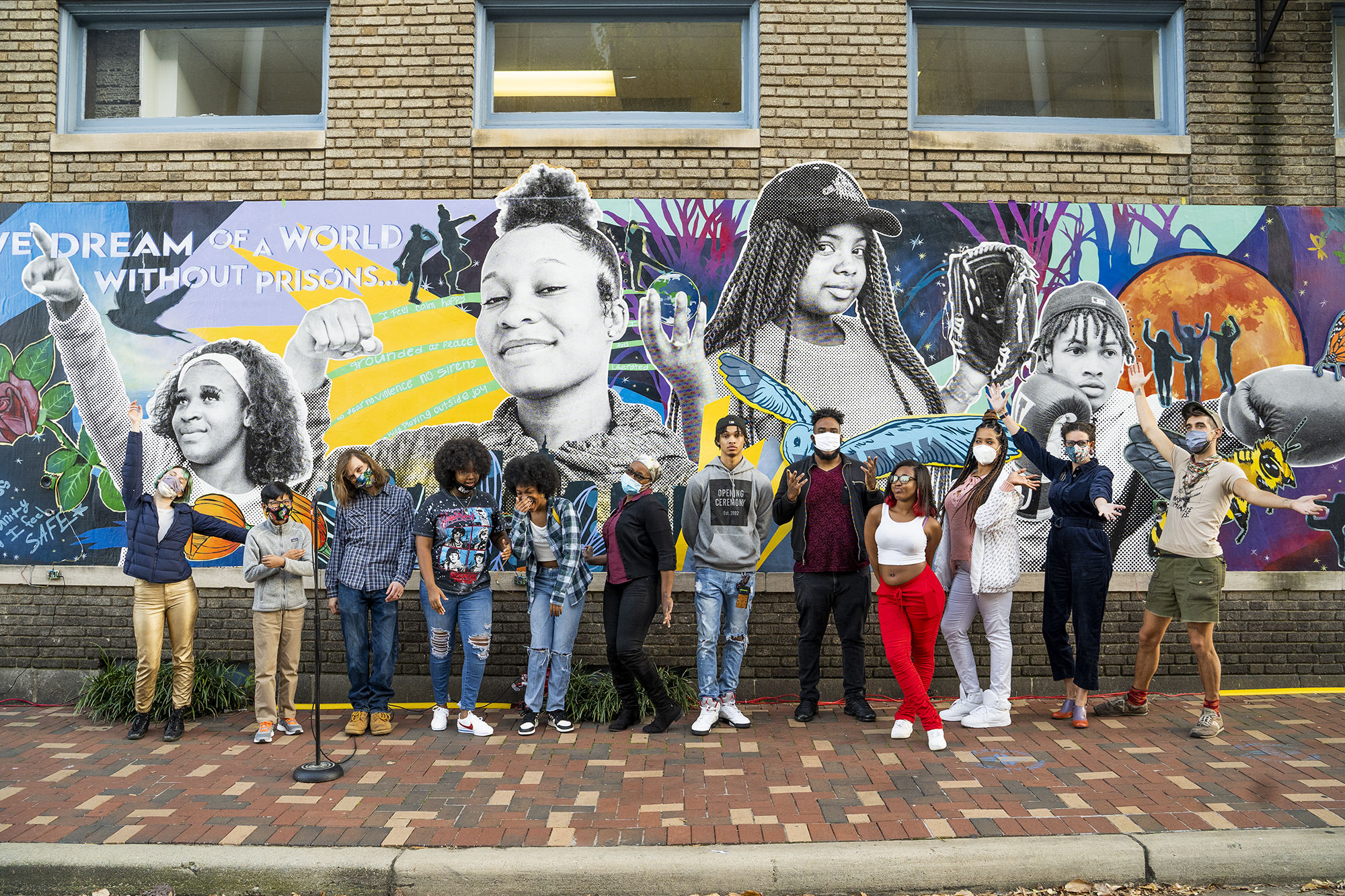
The creative team behind Freedom Constellations: Dreaming of a World Without Youth Prisons stands in front of their mural on the premiere day. From left to right: Natasha Kovacs (CodeVA instructor), Jakson (youth technologist), Zach Mulcahey (CodeVA instructor), Iyana (youth muralist), Ta’Dreama (youth muralist), Valerie Slater (RISE for Youth), Khai (youth muralist), Cory Jones (RISE for Youth), Kayla (youth muralist), Gina Lyles (Performing Statistics), Maggie Smith (CodeVA), Mark Strandquist (Performing Statistics). The mural was funded, in part, by RMHF. Image: Courtesy: Richmond Memorial Health Foundation

Montreal artist Junko manifests creatures from repurposed garbage

The city of Montreal is no stranger to public sculptures. Home to an eclectic collection of statues that are dotted across the map of the entire city, it’s hard to pick a walking path through the downtown area or Old Montreal that doesn’t pass by at least one eye-catching sculpture. Recently, some new sculptures have been popping up along the city’s snowy streets, and their creator refers to them as “glorified littering.” These eerie and interesting new forms are the creations of an artist under the pseudonym Junko, and as their creator’s name implies, they are composed of junk.


Junko began to publicly share his pieces at the end of December 2020 via his Instagram account. His first published post was on December 27th and showed off what was apparently his first endeavour into repurposing garbage as sculpting materials. “Working on this sculpture gave me a sense of purpose,” Junko states on the post. “As well as opened my eyes to the potential of creating sculptures from junk.”


Much of Junko’s work appear to take animal-like forms as well as feeling distinctly mechanical; the artificial skeletons of some long forgotten creatures. Car parts, bike frames, toy pieces, and all sorts of detritus make for materials in the artist’s sculptures- and sometimes even real animal bones. And while some appear to be small enough to easily pick up, others stand easily over ten feet tall and loom ominously and beautifully in the environments they have been placed in.


With the mixture of natural forms and unnatural ingredients, Junko’s creations meld interestingly into all sorts of city spots. They seem as at home in a desolate stretch of snow and trees as they do beneath the concrete of an overpass. The reception to his sculptures has generally been positive, if a bit quizzical, but it is certainly not too out of place to find such creative public pieces in areas such as the Mile End in Montreal, where several of his creations reside.


While apparently not authorized public pieces, Junko’s works are all still standing currently. The artist states that his work can’t necessarily be classified as vandalism as they are essentially “an organized pile of trash.” The works clearly take a lot of work and gumption to install, but with the city of Montreal still in a lockdown due to rising numbers of COVID-19 cases, there is perhaps no better an opportunity to undertake such an endeavour.


Junko’s work has a decidedly Montreal feel to it. It’s experimental but understandable, strange but familiar, natural and urban. The creatures he has crafted seem at home in the city they lumber in. And with spring somewhere on the horizon, here’s hoping that more of these litter critters will be waking from hibernation soon.

Gorky, Kandinsky Works to Make First Public Appearance Since 1970s at Sotheby’s London

Two extremely rare works by abstract expressionist pioneers, Arshile Gorky and Wassily Kandinsky, both from the collection of the same private European owner, will make their auction debut at Sotheby’s modern and contemporary art evening sale in London on March 25. The works are expected to bring in a collective £3.7 million, and they have not been publicly seen since the 1970’s when they were acquired by the current collector.

The Gorky work depicting a female figure was made between 1940 and 1941 as part of his “Garden in Sochi” series from the early 40’s. The series relates to the theme of Gorky’s childhood memories in his native country Armenia where the artist was inspired by memories of his father’s garden and farm. Two works from the series are in the Museum of Modern Art’s collection.

Gorky’s foray in the 1920’s into abstraction was largely influenced by modernists like Picasso and Kandinsky. By the 1940’s however, he was drawing inspiration from European Surrealists, like Joan Miró, André Masson, and Matta. According to Sotheby’s, high-quality works by Gorky rarely make it to auction. Good Afternoon, Mrs. Lincoln from the collection of Barney Ebsworth set the artist’s record at Christie’s New York in 2018, selling for $14 million. The Arshile Gorky Foundation is in the process of completing a major catalogue raisonné of the artist’s complete works.

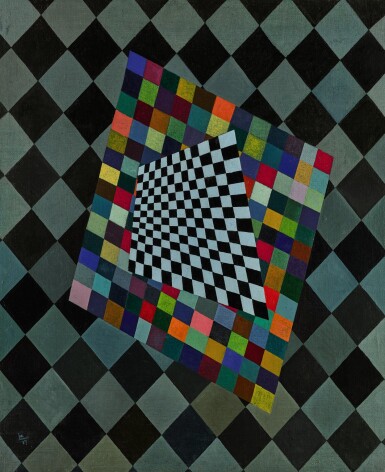
Quadrat (Square)
Wassily Kandinsky, Quadrat (Square), 1927

Kandinsky on the other hand completed his work, Quatre (Square) in 1927, roughly around the same time the artist developed his theory of abstraction, and following his invitation to join the Bauhaus school in 1921. The work features a checkerboard-like form that is warped to appear as though it recedes into space.

The current owner acquired the Gorky from Galleria Galatea in Turin, Italy, in 1971, and the Kandinsky was bought in 1975 through Galerie Maeght in Paris. Before its purchase, the Gorky work was shown widely throughout the postwar period, first at the Whitney Museum in 1951, then at MoMA in 1962, Tate Modern in 1965, and at the Metropolitan Museum of Art in 1969. The Kandinsky was featured at the Guggenheim Museum in 1963, the Fondation Maeght in 1966, and the Louisiana Museum of Modern Art in 1971 before being acquired by its current owner.

The March 25 evening sale will also include works by Paul Klee, Jean Dubuffet, Wols, and Jean Fautrier.

A Path for Arts and Gig Workers in California: A new report

A new report examines how recent labor policies intended to improve conditions for independent workers affect arts workers. The report Arts Workers in California: Creating a More Inclusive Social Contract to Meet Arts Workers’ and Other Independent Contractors’ Needs emphasizes ”the need to reimagine employment policies for the future of artists and gig workers.”

Authored by the Urban Institute, and commissioned by the Center for Cultural Innovation as part of its AmbitioUS initiative with funding from the Hewlett Foundation, the report seeks to ”help arts advocates, labor advocates, and policy makers create more inclusive systems that expand protections and benefits for all types of workers.”

Read the report here.