United Arts Agency | UAA

Category Archives: Call for Artists

New Report: Funding Narrative Change from the Convergence Partnership

“The report is authored by Rinku Sen and Mik Moore – leaders in social change narrative strategy, and we are very excited to share it far and wide, especially with funder networks who likely have had narrative change discussions bubbling up more and more. The report shares the deep gaps in understanding and funding approaches to narrative change, but more importantly, offers a framework for funders. It issues an urgent call for foundations to fund via Mass culture, Mass media, and Mass movement.”

“As a new strategic area of its work, the Convergence Partnership was interested in better understanding the ways in which “we” do “it.” Who are the “we?” Funders and practitioners that work in the narrative change arena. What is the “it?”Approaches to funding and bringing about narrative change. Established in 2007, Convergence Partnership (the Partnership) is a national funder collaborative working to transform policies, practices, and systems to advance racial justice and health equity. Given the nation’s fraught racial discourse, the Partnership believed narrative change and storytelling was a central strategy for shifting public attitudes toward racial justice and health equity. Today, the Partnership is led by eleven national, statewide, and local foundations and multifunder initiatives. In 2018, we hired Narrative Arts (then Working Narratives) and Moore + Associates to help us develop and implement a strategy to advance racial justice and health equity narratives with funders, grantees, and the Partnership itself. In the years since, they have conducted a series of trainings, audits, and workshops to help establish a shared understanding and approach to narrative change among these stakeholders.”

Read the full report here.

What We’re Reading: Why Is New York Asking Artists to Decorate City Garbage Trucks for Free?

“The New York City Department of Sanitation (DSNY) is seeking proposals from artists to decorate its 46,000-pound waste collection vehicles. But artists whose designs are selected will not be paid, raising questions about whether the city’s open call devalues art,” said Jasmine Liu for Hyperallergic. “DSNY is rebooting this public art project, Trucks of Art, for the second time, and will be accepting expressions of interest from artists until September 18. Its inaugural edition happened in 2019, when four artists and students in a visual arts class were selected to cover the 400-square-foot blank “canvases” with images of sanitation workers, recycling, and flowers. Almost 100 artists applied, and Sanitation Commissioner Kathryn Garcia at the time called the designs ‘truly … works of art.'”

“DSNY will privilege proposals that center the over 7,000 sanitation workers who keep New York clean and motifs of cleanliness. Participating artists will be provided with supplies and a working space to enact their designs, and they will have just three, seven-hour work days, sometime in late September and early October, to completely adorn their collection vehicle, including all three visible sides of the truck. They will be encouraged to keep waste low by using recycled and discarded paints. The design will remain on the truck for as long as it remains intact on the vehicle. The trucks are expected to hit the road by October, and DSNY hopes to represent artists from every borough.”

Read the full article here.

ICYMI: Pew Fellows Chat: angel shanel edwards, Jaamil Olawale Kosoko, and Alexandra Tatarsky on Blending Disciplines in Performance

From the Pew Center for Arts and Heritage: “The act of creation takes on a multiplicity of forms. In our ongoing artist interview series, we illuminate the distinctive artistic practices, influences, and creative challenges of our Pew Fellows, who represent a diversity of perspectives and creative disciplines.”

“In this installment, three performance artists—angel shanel edwards, Jaamil Olawale Kosoko, and Alexandra Tatarsky—discuss the audiences that motivate them, their dream collaborators, and the idea of “leakiness” between disciplines.”

About the Artists

Edwards creates movement work, film, and writing that celebrate the everyday, embodying the textures of Black queer and transgender existence, paying close attention to the overlooked joys and obligations of daily life in marginalized communities.

Kosoko’s performance works incorporate elements of dance, music, poetry, film, and visual art to reflect on Black and queer identity, often employing historical events and archival relics to speak to contemporary life.

Tatarsky’s work blends performance art, comedy, physical theater, and clown practices to probe the construction of meaning, self, and community, playing with perceptions of language and narrative structure and embracing humor to reveal vulnerability and humanity.

Read the full article here.

What We’re Reading: How Philanthropy Upholds White Supremacy

“Do you know much about philanthropy? Most people don’t,” said author Jessamyn Shams-Lau. “Philanthropy’s decision makers are not exactly representative of the general public, yet their influence has ripple effects on marginalized communities.”

“When we incorrectly believe or misunderstand that the contributions to foundations and donor-advised funds still belong to the founders, we reassign ownership of the foundation and the funds to them. This perpetuates a concentration of power at odds with representation, inclusion, democracy, and community.”

“Our understanding influences who holds power.”

“And in the case of philanthropy, power is often held by people who are furthest away from the communities served, spend the least amount of time studying the history, context, and data of issues being addressed, and are most likely to be involved in philanthropy due to family obligation, professional expectations, or the idea of ‘legacy.'”

“If founders truly divested control of foundation and DAF funds to diverse groups like this, money would flow more freely to Black and Brown communities. By maintaining control through board seats, founders and founding families exert undue influence in Black and Brown communities–by commission or omission–and carve out for themselves another well-heeled version of the white man’s burden.”

Read the full article here.

ICYMI: United Philanthropy Forum Welcomes New Board Directors & Officers

“At United Philanthropy Forum’s 2022 Annual Membership Meeting on July 19, 2022 in Seattle, WA, the Forum’s membership elected five new members to the Forum’s Board of Directors for three-year terms,” which include GIA President Eddie Torres.


Kyle Caldwell, President & CEO, Council of Michigan Foundations
Ann Esteban, Vice President, Finance, SoCal Grantmakers
Erik R. Stegman (Carry the Kettle First Nation Nakoda), Chief Executive Officer, Native Americans in Philanthropy
Eddie Torres, President & CEO, Grantmakers in the Arts
Marcus F. Walton, President & CEO, Grantmakers for Effective Organizations

“‘The Forum is honored to welcome these five stellar philanthropy leaders to the Forum’s Board of Directors,’ said Forum President & CEO David Biemesderfer. ‘They bring a valuable diversity of perspectives and skills that will serve the Forum well as we continue striving to achieve our vision of a courageous philanthropic sector that catalyzes a just and equitable society where all can participate and prosper.'”

“Also at the 2022 Annual Membership Meeting, Forum members honored four Directors who completed their board terms: Susan Taylor Batten, ABFE: Ret Boney, North Carolina Network of Grantmakers (formerly); Paul D. Daugherty, Exponent Philanthropy (formerly Philanthropy West Virginia); and Nick Deychakiwsky, Charles Stewart Mott Foundation.”

Read the full announcement here.

New Fund: Vermont Arts Council offers new Creative Aging Grants

“The Vermont Arts Council is offering a new grant program to provide meaningful arts learning experiences for older Vermonters, hoping to ease the social isolation that sometimes arrives as people age.”

“Creative Aging Grants provide up to $4,000 for organizations to provide skill-based arts instruction and intentional social engagement led by experienced teaching artists for older adults aged 60+.”

“Vermont nonprofit organizations, educational institutions, agencies of state government, counties, and municipalities are eligible to apply. This includes arts organizations, senior centers, and area agencies on aging. Collaborations with or among such organizations are welcomed.”

“Applicants may engage artists on the Council’s Creative Aging Teaching Artist Roster, which comprises experienced teaching artists that trained with Lifetime Arts to design creative aging programs that include skill-based instructional lessons and intentional social engagement opportunities. Applicants may submit proposals for projects led by teaching artists not on the roster. Priority is given to projects led by Vermont artists.”

The application opens on September 1 with a November 1 deadline to submit.Read the full announcement here.

AI-created art win’s Colorado State Fair competition

As all sectors in life become more and more inundated with the digital realm, we will of course keep seeing one of the same questions popping up in the art world—is art made by artificial intelligence really art? The hot topic has sprung up once again after the Colorado State Fair’s art competition with an AI-created artwork and ended up receiving first place with it.


Jason Allen, a game designer, had the text-to-image software Midjourney create three pieces which he submitted to the Colorado State Fair’s art competition priced at $750 each. Withholding the fact that they were created by AI, the piece Théâtre D’opéra Spatial won first prize—a science-fantasy scene viewed from behind of three figures in red and white flowing garments that appear on a platform, one taking an operatic position and seemingly performing with a radiant, circular portal gleaming across the space, centring the image.


Clearly, Allen had intent with this submission, claiming on his Discord server “I’ve set out to make a statement using Midjourney in a competitive manner.” And there is certainly nothing wrong with creating works using AI—or AI’s creating artwork, which seems more the case here as well as in concerted efforts such as Ai-Da. But there does seem to be a nihilistic and adversarial tinge to his motivations, taking a flippant tone in interviews and stating “Art is dead… It’s over. AI won. Humans lost.”


The judge for the Colorado State Fair has maintained that he still would have given the work first place on visual merit alone. There has been discussion of there being new categories implemented in competitions to separate AI-created art from human-created art, something even Allen suggested in the wake of this.


But the question of whether human art is over is a relatively absurd one. An inherent limitation of all AI—as set out in the evergreen logic of Douglas Hofstadter in the seminal Godel, Escher, Bach—is that it cannot think beyond the parameters by which its human creators have set down for it. Even a learning AI will always be limited in its inability to step outside of its processes to think truly outside the box. In this way, creative AI will only ever be able to make within their defined contexts, and it is not feasible that any will be powerful enough to create across the entire spectrum of what is capable of humans to produce accurate results to the degree that humans will be rendered obsolete.


But even if such an AI was the case—any artist that would throw down their brush is an artist of little heart. There will always be a hand, whether of flesh or code, that can create in a way near-identical to your own. That is no reason to do away with the process of letting ideas flow from the mind to the world to share in the act of creation; it will always be a vital and celebrated aspect of humanity, even long after this world loses any form of AI. Jason Allen and Midjourney’s victory in no way compromises the sanctity of art, nor the Colorado State Fair.

September Member Spotlight: Frey Foundation

Frey Foundation, a GIA member since 2013, is a family foundation based in Grand Rapids, Michigan that is committed to making a difference in the lives of individuals, families, organizations, and communities. Grants are awarded to non-profit organizations primarily in West and Northern Michigan for projects that enhance child development, protect natural resources, promote the arts, and build community.

We view the arts as a key indicator of community health, and a powerful tool for individual expression. Our goals are to stimulate the vitality, effectiveness, and growth of community-based arts and to encourage community engagement in cultural experiences, particularly among children. A recent project supported by the Frey Foundation, The 49507 Project, exemplifies these priorities and uses public art to celebrate and connect communities.

The 49507 Project is an initiative of The Diatribe, a grassroots organization led by a group of nontraditional teaching artists. It engaged youth from its arts programming during community listening sessions with residents to gather creative input to understand how they imagine themselves and how they want to see their neighborhoods evolve. Michigan-based artists of color synthesized these ideas and designed seven large scale murals that celebrate and reflect Black and Brown lives, culture, and experiences in neighborhoods in Grand Rapids’ 49507 zip code. Murals were installed on prominent buildings and unveiled at well-attended community celebrations. The result is not only beautiful but powerful.

We encourage you to learn more about The Diatribe and The 49507 Project by visiting thediatribe.org. You can also find more information about the Frey Foundation and our grantees at freyfdn.org.

You can also visit the Frey Foundation photo gallery on GIA’s Photo Credits page.

Archaeologist calls for return of the Rosetta Stone to Egypt

As we have seen more and more nations that were victimized by the theft and looting of colonial practices come forward with demands for the return of ill-gotten goods, it’s doubtless that we’ll be seeing more and more high-profile items in these claims. And few historical artifacts have more prestige than the legendary Rosetta Stone, which this past week has seen a demand for its return from the British Museum.


Zahi Hawass, a renowned Egyptian archaeologist, called for several artifacts to be returned from European sites that rightfully belong to Egypt. These were the Dendera Zodiac ceiling, a bust of Nefertiti, and the Rosetta Stone, each held at the Louvre, States Museums Berlin, and the British Museum respectively. This is not the first endeavour to attempt to have European leaders admit to historical wrongdoing and return stolen artifacts, Hawass having petitioned for it since 2003.


But there may be more hope for the desire two decades later. We’ve witnessed the return of artwork by way of the scandals that rocked the Louvre in relation to former director Jean-Luc Martinez, as well as the groundbreaking agreement between Nigeria and Germany for the return of their Benin bronze statues. The situation has also been discussed in lighter and more public light by virtue of James Acaster’s scintillating bit during a stand-up special on the British empire, perhaps swaying a more indifferent western public on this issue.


The Rosetta Stone is, of course, the legendary artifact that was used to understand the language of Ancient Egyptian hieroglyphs by linguists and archaeologists. Created in 196 BCE, the Napoleonic army happened upon it in 1799. It then transferred hands again to the British upon defeating the French and has remained in the possession of the British since 1802.


While there is no denying the importance of the Rosetta Stone and what wisdom has been gleaned from it, there is no denying that this piece of Egypt’s cultural identity was stolen. Especially given that the west has extracted the information of this piece, there truly is no reason for it to remain in their unjust possession any longer. With any luck, Zahi Hawass will finally see his decades of effort paying off and Egypt will once again house one of the world’s most stunning treasures of history.

Working for Black August: Black Arts & Culture Funding and Justice Resource Hub

Throughout this resource hub, we aim to amplify funds and resources that explicitly center Black artists, cultural communities, and experiences. Additionally, we borrow a lens from the BIPOC project1 that centers Black and Indigenous folks – whose experiences shape relationships for all ALAANA/POC people’s relationships with white supremacy culture – as another dimension of resource and financial investment intended to realize justice.

This hub is curated with the intention of identifying and amplifying funds and resources that support Black artists, culture, and communities. We recognize that this is an incomplete list that we expect to evolve and hope will expand.

Funding for Black Artists and Cultural Communities

The Black Donors Project – Black Donors Project surveys Black donors who give to the arts with a goal to measurably shift financial support for Black art by identifying Black giving preferences of Black donors for Black artists, Black-led arts organizations, and Black-owned galleries.
Pittsburg’s Cultural Treasures – Pittsburgh’s Cultural Treasures, will focus first on supporting Black cultural organizations. Some of the grants may range from $500,000 to $1 million and will pay out over multiple years.
Black Artist Fund – A micro- and small grant fund started by Sacramento black creatives to address inequity in arts funding.
Black Art Futures Fund (BAFF) – A collective of emerging philanthropists promoting the elevation and preservation of Black arts & culture and seeking to amplify and strengthen the future of Black art.
Advancing Black Arts in Pittsburgh – A joint grantmaking program committed to helping create a vibrant cultural life in Pittsburgh and the region for Black artists and cultural organizations that focus on Black arts.
Black-Led Movement Fund at Borealis Philanthropy – Supporting organizations working to advance the vision of young, Black, queer, feminist, and immigrant leaders. In particular, we prioritize funding organizations who are actively leading and anchoring the Movement for Black Lives
NBAF (National Black Arts Fund) – Artist Project Fund to support Black Artists in getting back to work and thus provide for their households.
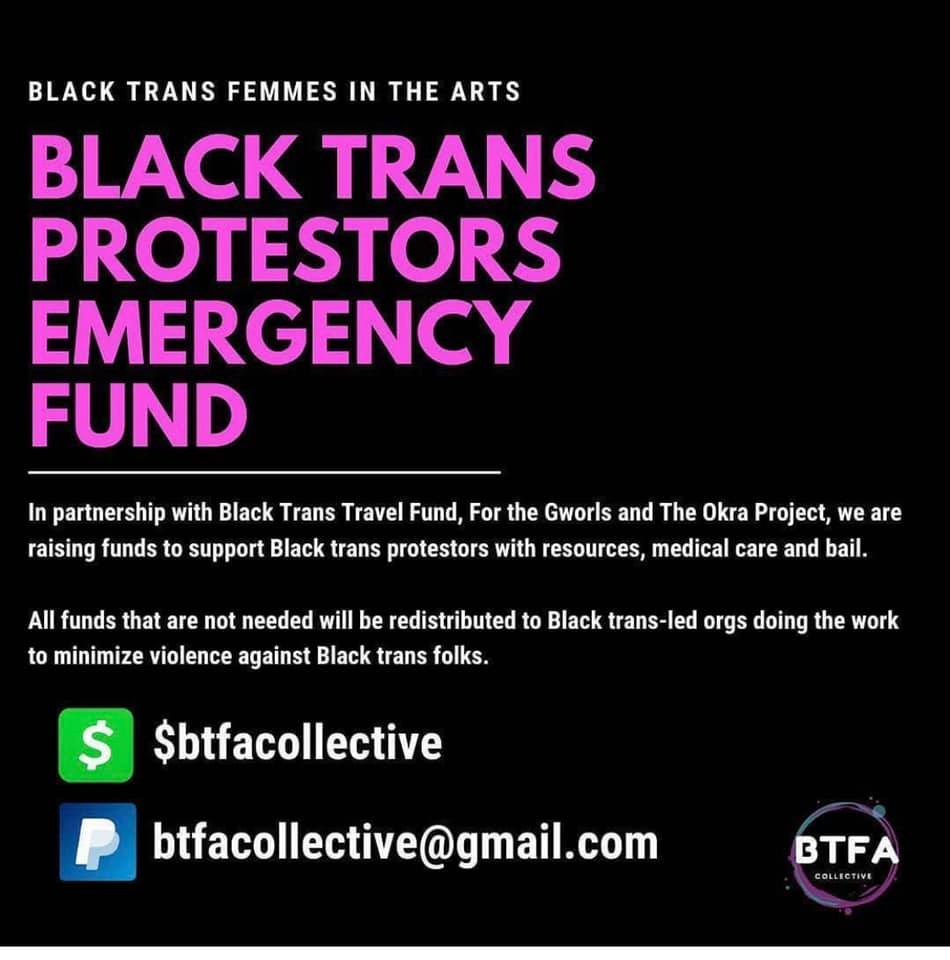
Black Trans Protestors Emergency Fund from Black Trans Femmes in the Arts (BTFA Collective)
ArtsWave Grants for African American Arts – Connecting local Black arts and cultural innovators with access to resources and opportunities to grow and thrive, new in 2020.
#DefendBlackLife Response Funds & Black-Led Organizing Work – This compilation of Rapid Response Funds, general funds for Black-led organizing, and Black-led organizing work to support for the long term has been curated by Justice Funders for the purpose of tracking, sharing information and supporting movements for justice.

Funding for BIPOC Artists and Cultural Communities

Belonging in Oakland: A Just City Fund (Cultural Affairs Division City of Oakland) – To generate an array of possible answers to that provocative question, we turn to community-rooted BIPOC (Black/Indigenous/People of Color) visionaries, artist activists, and resilient culture keepers to help us imagine new landscapes and narratives, liberate deferred potential, recover old wisdoms, and unleash radical hope.
Take Notice Fund (National Performance Network) – NPN envisions a world in which artists of color living and working in the South have the power, resources, and opportunities to thrive. The Take Notice Fund honors BIPOC artists living and working in Louisiana, providing funding to advance their artistic practices.
26 Organizations You Can Donate to That Support Emerging Black Artists, Thinkers, and Change-Makers – Organizations across the U.S. thst aim to foster the careers of aspiring Black creatives in a variety of ways.
REACH Fund at Borealis Philanthropy – Tackling liberatory possibilities and funding to reach that goal.
BIPOC Artist Fund at The Sable Project – dedicated to providing funding for Sable artists who identify as Black, Indigenous, and/or People of Color.
Mobilize Power Fund at Third Wave Fund – A rapid response fund that supports the leadership of young women of color, trans, gender non-conforming, queer, and intersex youth under 35 in social movements, regardless of 501c3 status or fiscal sponsorship.
Critical Minded – Granting and learning initiative to support cultural critics of color in the United States, where they are underrepresented in the coverage of all artistic disciplines.

Advocacy, Movements, and Networks

Black Social Change Funders Network – A network of funders committed to creating thriving Black communities by strengthening the infrastructure for Black-led social change.
Black Philanthropic Network at ABFE – A group of nine regional affinity groups whose focus is to support philanthropy in Black communities and that is in alignment with ABFE’s mission to promote effective and responsive philanthropy in Black communities.
Invest/Divest from the Movement for Black Lives – The Movement for Black Lives launched the Vision for Black Lives, a comprehensive and visionary policy agenda for the post-Ferguson Black liberation movement, in August of 2016.
Invest/Divest created by Funders for Justice a Program from Neighborhood Funders Group – Addressing how we “reallocate power and resources back to our safety, back to our health, in ways that help us thrive, and that don’t criminalize or dehumanize us.”
Black Lives Matter Arts+Culture – uplifting Black artists, educating Black communities on the intersection of art, culture, and politics, and disrupting the status quo of the art world by uplifting emerging Black artists who speak audaciously, who are unafraid, and who stand in solidarity with the most marginalized among us.
The Center for Cultural Power – a women of color, artist-led organization, inspiring artists and culture makers to imagine a world where power is distributed equitably and where we live in harmony with nature.

Anti-Racist Reading List

Schomburg Center Black Liberation Reading List – “In response to the uprisings across the globe demanding justice for Black lives, the Schomburg Center has created a Black Liberation Reading List. The 95 titles on the list represent books we and the public turn to regularly as activists, students, archivists, and curators, with a particular focus on books by Black authors and those whose papers we steward.”
“How to Be an Antiracist: A Conversation With Ibram X. Kendi” – An interview with Dr. Kendi challenging traditional definitions of racism, who can be racist, and how to work differently to create an anti-racist society.
“What is an Anti-Racist Reading List For?”
“We Must be in It for the Long Haul” – Black Foundation Executives Request Action by Philanthropy on Anti-Black Racism
“Crisis Funding is Not Enough: Invest in Black Communities⁠ for the Long Term” – Borealis Philanthropy’s call to investing in long-term partnerships with communities working to end anti-Black violence and police brutality, and build lasting freedom and dignity for Black and other communities of color.
Justice Funders’ Dismantling White Supremacy & Anti-Blackness in Philanthropy – An exploration and acknowledgment of “the ways in which our institutions and our field at large have perpetuated these systems of oppression.”
“The Case for Funding Black-Led Social Change”
“Nonprofits Led by People of Color Win Less Grant Money with More Strings”
“Through Pop Culture, Can We Imagine Life Beyond White Supremacy?”
“Race in the Writers’ Room: How Hollywood whitewashes the stories that shape America”
“Conversation Claudia Rankine: On Whiteness” MacArthur Foundation Fellow and acclaimed author Claudia Rankine presents an investigation of the historically unquestioned role Whiteness plays in race relations.
“What does an equitable economy look like?”
“Statements About George Floyd Are a Start, but How Will Organizations Live Their Values?”
“Redlining by Another Name: What the data says to move from rhetoric to action”

Photo by Clay Banks on Unsplash

“We use the term BIPOC to highlight the unique relationship to whiteness that Indigenous and Black people have, which shapes the experiences of and relationship to white supremacy for all people of color within a U.S. context.” From https://www.thebipocproject.org.